



Most small and mid-size businesses that call a corporate video production company can describe what they want (“a video for the website,” “something for LinkedIn”) but not the job it needs to do. That gap gets expensive.
A video meant to train a new hire on your intake process and a video meant to convince a stranger to fill out a contact form have nothing in common beyond the word “video.” A production company that quotes a package before asking which job you need will hand you something polished that may not move the needle for your business.
91% of businesses now use video as a marketing tool, and 83% of video marketers say it directly increases sales, according to Wyzowl’s 2026 State of Video Marketing report. That return only shows up when the video was built to solve the problem sitting in front of it.
Blue Halo is a Miami video production agency that helps brands create commercial, corporate, and social media video content, and every project starts with the same question this article is built around: what job does this video need to do?
Types of Corporate Video Production
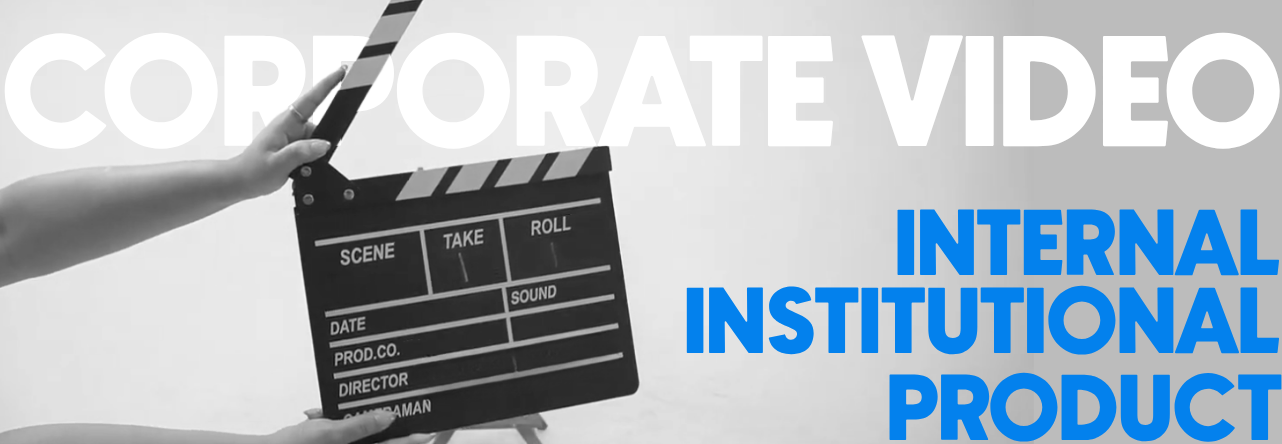
When we break corporate video down by the job it does, three real categories emerge:
- an internal communications video, built for people already inside your company
- an institutional video, built for a stranger getting to know you
- a product video, built to help a buyer make up their mind
Each earns its budget through a different mechanism, worth understanding before you brief anyone.
What Internal Communications Video Does for Your Company
An internal communications video is built for an audience that already has a relationship with you: employees, candidates deciding whether to apply, a new hire learning how things work here. None of them are shopping for what you sell, so the video’s job is to inform, reassure, or rally the people who already work with you.
Training is where the category earns its budget fastest. Say twenty new hires each need the same 45-minute walkthrough of your intake process. Having a manager run that live twenty times means explaining the same thing over and over, every hiring cycle, on top of whatever that manager should have been doing instead. A single piece of corporate training video production gets recorded once and watched as many times as you have new hires, for as long as the process stays the same.
Training isn’t the only job this category does well. The same format builds excitement and connection among people already on your team: a benefits rollout, a culture update, a recap of the year, told well on video, gets watched and shared in a way the same information in an email never does. That’s harder to put a dollar figure on than hours saved, but it’s often the difference between an announcement that lands and one that gets skimmed and forgotten.
What Institutional Video Does for Your Business
An institutional video, sometimes called a brand video, is where a stranger gets their first real impression of your business. The moment someone lands on your site, they’re skeptical by default. This video’s job is to earn trust before they ever talk to a salesperson: show them who you are, what you do, why you do it, and how you do it day to day, and skepticism starts to turn into the beginning of a relationship. This is also generally where investor-facing video lives, since that audience (shareholders, analysts, the wider financial community) is sizing you up the same way any outside stakeholder would.
That’s a lot to carry in a few minutes, and it doesn’t happen through narration alone. The visuals, the pacing, and the style you choose all tell the story as much as the words do. An institutional video can be shot as a series of interviews, built around a voiceover, or carry no dialogue at all and let music and footage do the work. None of those approaches is more “correct” than another. The right one depends on your audience, your values, and what you’re actually trying to get across, which is exactly why this category is worth briefing with a professional instead of handing off a shot list and hoping for the best.
Done well, this is usually the best opportunity you’ll get to humanize your business. A home page and a services page tell someone what you offer. An institutional video lets them hear a voice, see a face, and get a sense of the people behind the work, and that’s what helps build trust that you’re genuine, showing people quickly and visually who you really are. It typically lives permanently on your homepage or about page, built to hold up for years rather than tied to a specific offer or date.
What Product Video Does for Your Sales Process
A product video demonstrates a specific offering: what it does, how it works, and why it solves a problem the viewer already has. B2B buyers increasingly research a product on their own before agreeing to a sales call, and a product video is one of the few formats that lets you control that narrative instead of leaving it to a review site or a competitor’s comparison page.
A brochure or a spec sheet can tell someone what your product does. It can’t show them. A niche capability that’s hard to explain in a bullet point makes a lot more sense once someone can see it in action. So does the way your product works alongside something a buyer already owns, or the specific steps involved in using it. Those are things people need to see, not read. And hearing someone walk through it does something text can’t: it’s more digestible and easier to remember, which matters when the person watching is trying to decide between you and three competitors with the same feature list.
Bonus: Campaign Videos
Any of the three types above can also show up inside a campaign, which is why campaign videos aren’t a fourth category of their own. They’re a different way of deploying one you already have, built to push toward a specific action within a limited window: driving signups for a launch, awareness for a seasonal promotion, or clicks on a paid push. What they all have in common is a shelf life, a start date and an end date. A campaign video usually lives somewhere with a media budget behind it, like a social ad or a landing page, rather than sitting on your site for your audience to visit anytime. Once the push ends, the video’s job is done. That’s exactly how it’s supposed to work.
Matching the Type to the Problem You’re Solving
The question to ask yourself is what challenge you’re facing right now. If your managers are wasting time explaining the same process to every new hire, or an announcement keeps landing flat, that’s a job for an internal communications video. A homepage that gets traffic but no contact form fills points to an institutional video. If people don’t know everything your business offers and end up at a competitor instead, that’s a product video problem.
Most businesses eventually need all three, at different points, for different reasons. That’s exactly why when you’re looking for a corporate video production company, prioritize the one that asks what challenge you’re solving before giving you a quote.
The Bottom Line
If you’ve read this far, you probably already know you have a challenge a video could solve. Video is one of the primary ways people communicate and make decisions today, and the businesses getting return from it are the ones matching the type of video to the problem in front of them. An internal communications video builds trust and connection with the people already inside your company. An institutional video earns trust with a stranger who’s still deciding whether to believe you. A product video helps a buyer make up their mind with specifics a brochure can’t show.
Blue Halo has handled video production for a variety of clients, but most extensively with AMMEGA Group, where the work ranges from product spotlights to full campaign video. You can see some of that client work here.
Figuring out which one you’re solving for is worth doing before you spend a dollar on corporate video production.
Learn about our Miami video production services
Ready to get started? Contact Blue Halo to get your corporate video production started. We’ll help you match the type to the problem first.