


Most brands land in one of two places at a trade show. Some skip real design altogether: a folding table, a tablecloth, and a stack of business cards, because the product or the sales pitch is supposed to carry the booth on its own. Others go the opposite way: a sharp, expensive-looking build that photographs beautifully and does nothing once people walk up, because nobody thought past the backdrop.
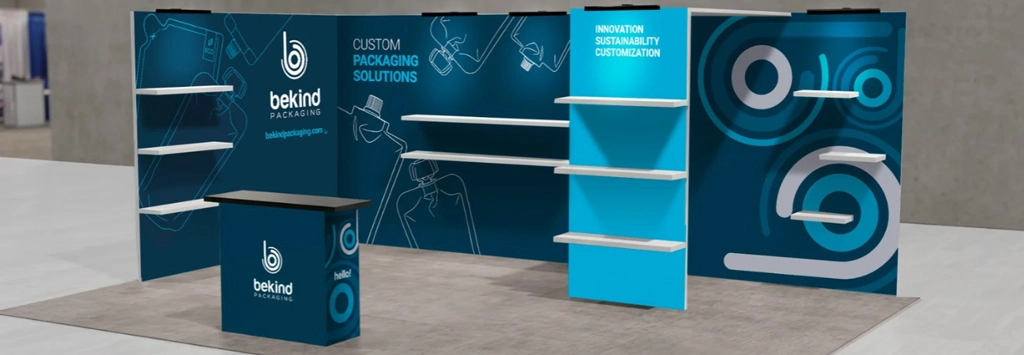
A booth that looks thrown together loses credibility and doesn’t pull people in to learn about you, so it has to look good. But looking good is only part of it. Knowing how to design a trade show booth means treating every visual choice as a tool with a job to do: getting attention, making your message clear, giving people a reason to stop, and turning that stop into a conversation.
Here’s your guide to creating a booth design that does that
Make People See You From Across the Floor
Before anyone can read your messaging or talk to your team, they have to notice you exist. Attendees walk entire show floors in a few hours, and a surprising number of booths get skipped simply because they don’t stand out. A plain table and banner setup doesn’t give anyone a reason to look twice.
- Claim your spot visually, not just physically. A good location (near an entrance, a main aisle, a popular attraction) helps, but you can’t always choose it. What you can control is height, color, and contrast. Tall structural elements and bold, on-brand color make a booth readable from 50 feet away, which is often the distance that decides whether someone walks toward you at all. It’s the same thinking behind the backdrops and banners Blue Halo Agency built for AMMEGA Group: materials designed specifically to stand out on a crowded expo floor and pull people toward the booth, not just announce that it’s there.
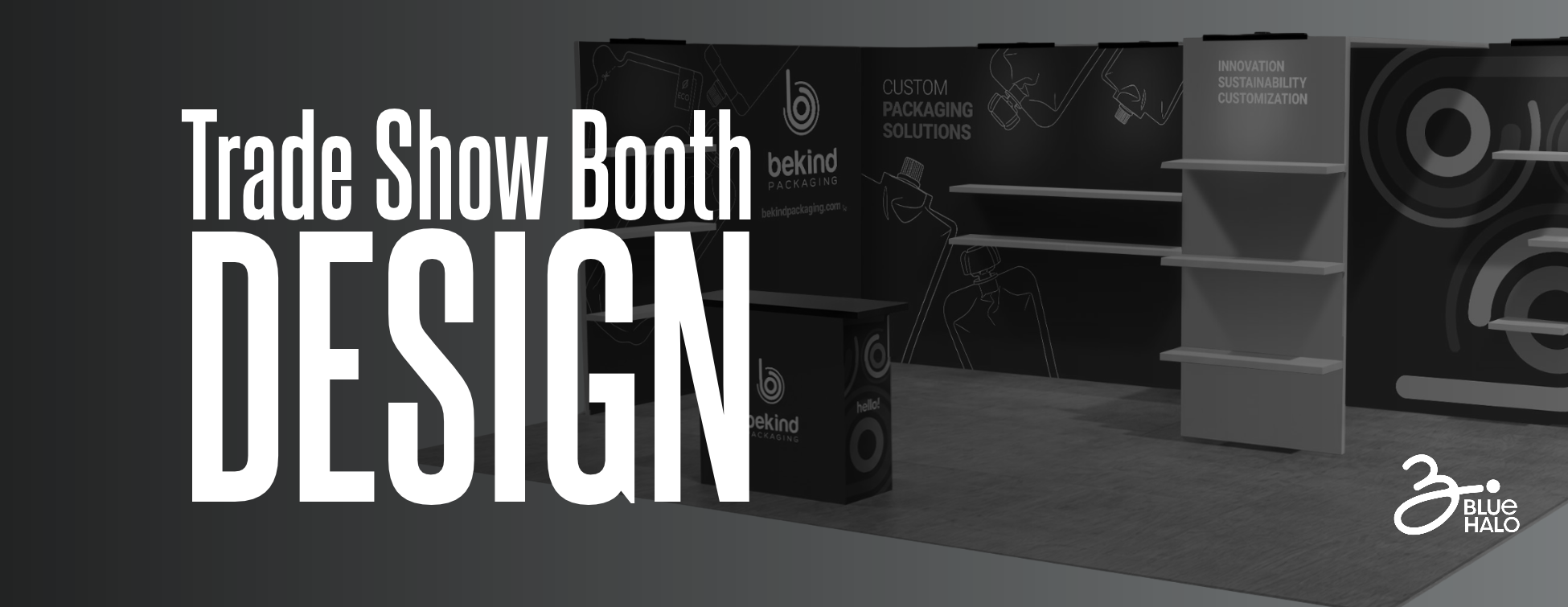
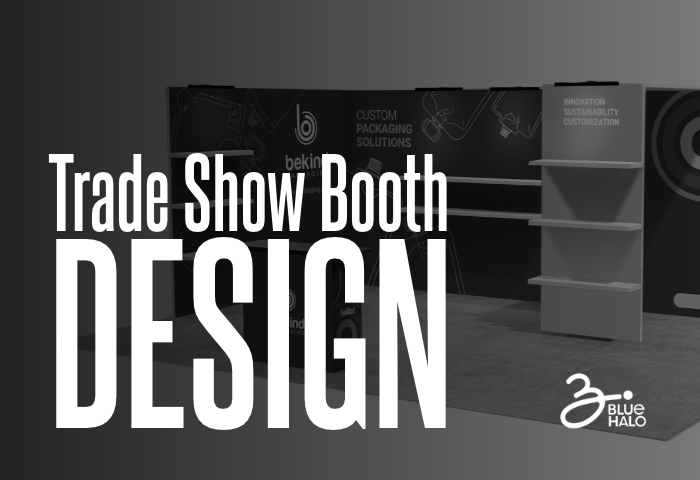
- Light it like you mean it. A booth lit the same flat way as the aisle around it doesn’t register as a destination worth walking toward. Accent lighting on your sign, your logo, or one key product gives people something to focus on from a distance — TradeGroup’s own exhibit designers note that lighting works best aimed at one or two focal points, not spread evenly across the whole space. This booth build shows exactly that.
- Make your signage work from every angle. Signage that’s small, placed too low, or blocked by your own display defeats the purpose of having it. Your company name and what you do should be legible to someone walking past, not just someone already standing in front of you.
- Don’t let clutter undo the effort. An overloaded display with too many messages competing for attention reads as unwelcoming, even when every individual element looks good on its own. A simpler booth with one clear focal point consistently outperforms a busier one.
Say What You Do Before They Ask
Once you’ve got someone’s attention, you have seconds, not minutes, to tell them why they should care. This is where trade show booth design and copywriting have to work together instead of competing for space.
Lead with a single, plain-language message: who you are and what problem you solve. Avoid using too much text. The booth’s job is to pull people in to have conversation, it shouldn’t give the whole pitch away. Tradeshow booth design that tries to say everything at once usually ends up saying nothing clearly. Ramsey Industries’ trade show materials are a good example of the opposite: just a banner, a tablecloth, and printed materials, carrying one consistent look and message at every show instead of a dozen competing ones.
Give Visitors a Real Reason to Stop
Being visible and clear gets someone’s attention for a moment. What keeps them from walking on is a real reason to stop: an offer, a demo, a question your booth promises to answer, something more specific than “come see us.” Booths that skip this step are often the ones with decent foot traffic but often lack engagement. People glance, register the branding, and keep moving because nothing signaled that it was worth stopping.
Convention booth design choices matter here too, beyond pure looks. A booth built around one interactive or informational hook (“see how this works,” “find out what this costs you”) gives people a concrete reason to break stride that pure branding can’t. CEIR’s 2017 Attendee Floor Engagement Study found interactive product displays engaged 78% of attendees and educational games engaged 67%, both well above what a passive display alone produces.
Trade show booth ideas worth building around usually involve the visitor directly: a working product demo instead of a photo of the product, a short interactive quiz instead of a stack of flyers, a hands-on station, even a game if you want to get creative. You don’t need something elaborate. You need something a visitor does, because doing something automatically gets people in for minutes at your booth.
Design the Booth So Staff Can Do Their Job
A booth’s layout either helps your team have good conversations or gets in the way of them. Open sightlines, a clear path in, and space for two people to talk without blocking the aisle all matter more than they get credit for. A beautifully designed booth that’s cramped or maze-like quietly pushes visitors back out before a conversation can start.
Most exhibitors underplan for this part of the job. The same CEIR study found 81% of B2B attendees said talking with sales or marketing staff was one of the ways they engaged at a booth, the single highest-rated form of engagement it measured. Your staff can only deliver that if the physical design gives them room to do it: visible from the aisle, approachable rather than walled off, and stocked with the answers to the questions your signage is inviting.
Build Lead Capture Into the Booth
A great conversation that never makes it into your CRM didn’t accomplish much. Lead capture has to be designed into the booth itself, not left to whatever a rep remembers to write down afterward. A visible QR code, a tablet station, or a simple way to scan a badge keeps the handoff from the floor to your pipeline from depending on memory.
Decide before the show how you’ll know whether the booth worked. Tracking real traffic and leads against your goals is what tells you whether a design choice paid off, and that’s the information that makes next year’s booth better and more successful.
The Bottom Line
Knowing how to design a trade show booth comes down to the same habit whether your current setup is a folding table or a full custom build: tie every visual choice to a real job it has to do, from getting noticed to capturing the lead. Good looks get you in the conversation. Strategy is what keeps you in it.
Need a booth that looks as good as it performs? Blue Halo’s event management team handles exactly this, from the visual identity to the floor plan that makes it work. Get in touch and let’s talk about your next show.